One Color, Two Dozen Names: The Most Duplicated Paint Color in America
Explore colors in this guide
Open a color for its details and cross-brand alternatives. Read on for the context behind each choice.
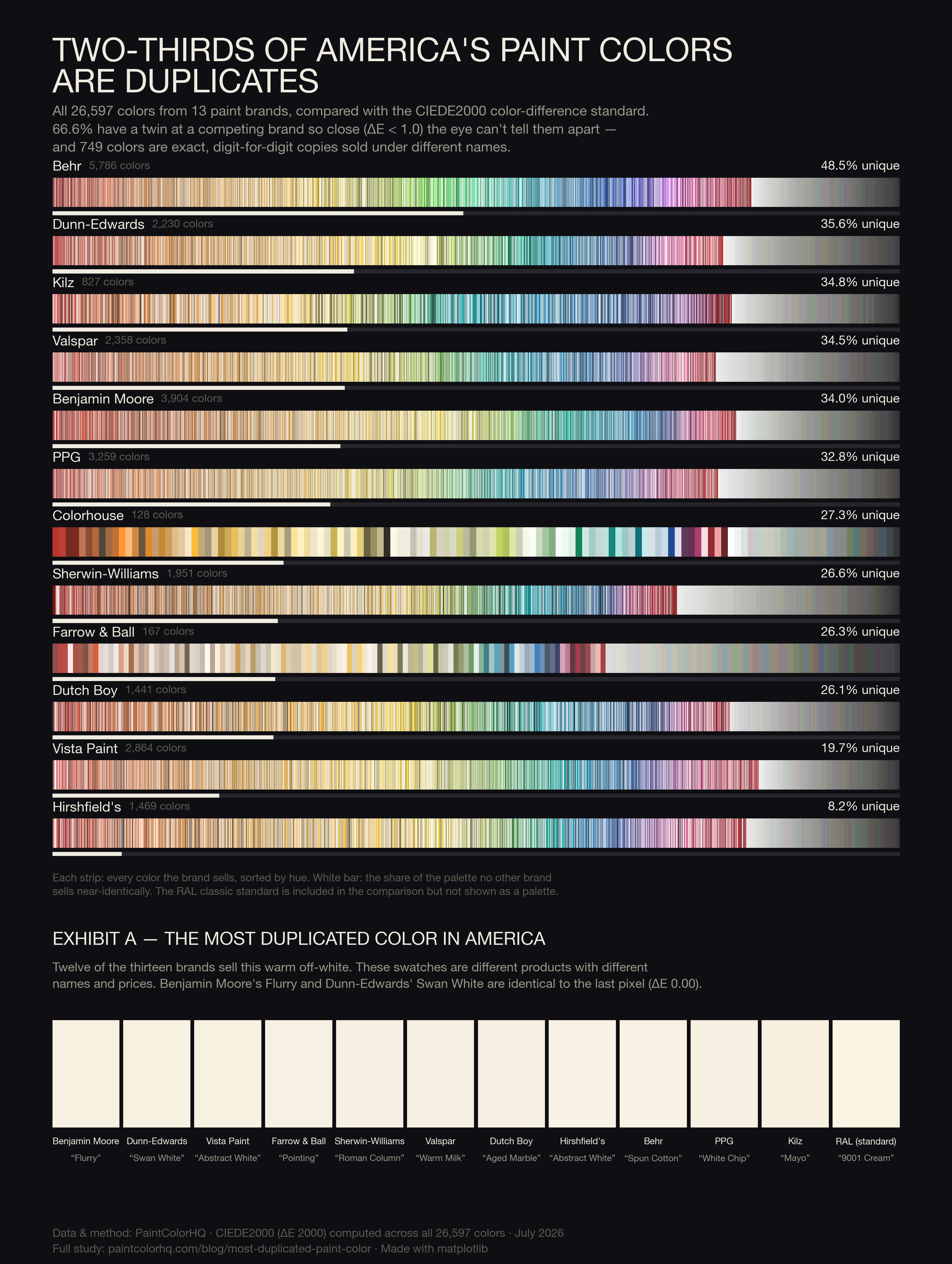
We ran a simple question against our full database: how much of the American paint aisle is the same paint wearing different names? The dataset is every color we track — 26,597 colors across 13 brands — and the measure is CIEDE2000 (Delta E 2000), the color-difference standard paint manufacturers use for quality control. A Delta E below 1.0 means two colors are near-identical: most people cannot tell them apart even side by side. The answer: 17,702 colors — 66.6% of everything on the market we track — have at least one near-identical twin at a competing brand.
The Most Duplicated Color in America
The single most duplicated color is a warm, slightly creamy off-white. Benjamin Moore sells it as Flurry (CC-100). Dunn-Edwards sells the numerically identical color — the same hex value, a Delta E of exactly zero — as Swan White (DEW346). In total, 12 of the 13 brands we track sell a version of this shade close enough that you could swap one for another mid-wall and never spot the seam — at least two dozen named colors in all. That list includes one of the most famous designer whites in the world: Farrow & Ball's Pointing (2003), a premium-priced classic that is, colorimetrically, the same shade as the big-box versions below.
| Brand | Their name for it | How close |
|---|---|---|
| Benjamin Moore | Flurry CC-100 | the reference |
| Dunn-Edwards | Swan White DEW346 | identical (ΔE 0.00) |
| Vista Paint | Abstract White 1027 | ΔE 0.41 |
| Farrow & Ball | Pointing 2003 | ΔE 0.42 |
| Sherwin-Williams | Roman Column 7562 | ΔE 0.46 |
| Valspar | Warm Milk 8007-8B | ΔE 0.46 |
| Dutch Boy | Aged Marble 006W | ΔE 0.46 |
| Hirshfield's | Abstract White 1027 | ΔE 0.48 |
| Behr | Spun Cotton YL-W09 | ΔE 0.51 |
| PPG | White Chip 15-06 | ΔE 0.58 |
| Kilz | Mayo LD200-01 | ΔE 0.98 |
| RAL (standard) | 9001 Cream | ΔE 0.99 |
One near-identical twin shown per brand (Delta E 2000 vs. Flurry; under 1.0 is not distinguishable side by side). Colorhouse is the only tracked brand without one.
749 Colors Are Literally Identical Across Brands
Near-identical undersells some of it. 749 exact color values — same hex, digit for digit — are sold by two or more brands under different names, covering 1,555 named paint colors. In the most extreme cases, four brands sell the same exact value. Flurry and Swan White above are one of those pairs: not close, not similar — the same color target with two names and two price tags.
The Most (and Least) Original Palettes
Flip the question: what share of each brand's palette exists nowhere else — no near-identical twin at any other tracked brand?
| Brand | Palette size | Colors unique to the brand |
|---|---|---|
| Behr | 5,786 | 48.5% |
| Dunn-Edwards | 2,230 | 35.6% |
| Kilz | 827 | 34.8% |
| Valspar | 2,358 | 34.5% |
| Benjamin Moore | 3,904 | 34.0% |
| PPG | 3,259 | 32.8% |
| Colorhouse | 128 | 27.3% |
| Sherwin-Williams | 1,951 | 26.6% |
| Farrow & Ball | 167 | 26.3% |
| Dutch Boy | 1,441 | 26.1% |
| Vista Paint | 2,864 | 19.7% |
| Hirshfield's | 1,469 | 8.2% |
RAL is excluded here — it is an industrial color standard, not a decorative paint line. Two honest caveats: a bigger palette naturally claims more unique territory, which flatters Behr's number; and regional brands like Hirshfield's and Vista Paint serve customers who ask for national colors by name, so tracking those palettes closely is part of the job, not a knock on them.
Even the premium end converges: about three-quarters of Sherwin-Williams and Farrow & Ball colors have a near-identical twin somewhere else. The most intertwined pair of brands is Behr and Benjamin Moore — roughly 2,400 colors in each palette have a near-identical counterpart in the other.
Why the Paint Aisle Converges
Three forces push palettes together. First, demand piles up in a small corner of color space — whites, off-whites, greiges, and soft grays dominate what people put on walls, so every brand needs dense coverage exactly there. Second, matching a competitor's bestseller is normal practice: paint stores field “can you make Agreeable Gray?” requests every day, and brands answer by shipping their own version. Third, regional brands maintain equivalents of the national palettes their customers name-check. The result is a market where the name and the can are brand-specific, but the color itself often is not.
What This Means When You're Buying Paint
You are less locked in than the sample-card racks suggest. If you love a color but prefer another brand's price, availability, or a specific product line, there is a two-in-three chance a near-identical version exists — every color page on this site lists them, and the compare tool shows any two candidates side by side. The one thing the math cannot standardize is the paint itself: formulas, sheens, and coverage differ between brands even when the color target is the same, so confirm the winner with a physical sample on your own wall before buying gallons.
Methodology
We computed CIEDE2000 (Delta E 2000) differences across all 26,597 colors in the Paint Color HQ database — 12 decorative paint brands plus the RAL classic standard — as of July 2026, treating pairs under Delta E 1.0 as near-identical. Color values come from each brand's published palette data; the conversion pipeline and thresholds are documented on our methodology page. Brand palettes change, so counts shift slightly as we import updates. If you cite these findings, please link to this page so readers can check the current numbers.
Addendum: How Many Distinct Colors Are There, Really?
A sharp reader question after publication: does “two-thirds are duplicates” mean only a third of the catalog is unique, or that the whole catalog collapses to a third of its size once you merge duplicates? Those are different numbers, and the headline stat is the first one: 66.6% of catalog entries have at least one near-identical counterpart at a competing brand, and 33.4% (8,853 colors) have none.
The second question — how many distinct colors the market actually contains — is trickier, because near-identity is not transitive: color A can be a twin of B, and B of C, while A and C are visibly different. Merge every chain naively and you get 11,879 “distinct” colors, but one chained mega-cluster of 6,947 whites, off-whites, and greiges forms along the way, and its endpoints are clearly not the same color. A more defensible answer uses representative-based clustering, where every member of a group must be near-identical (Delta E under 1.0) to that group's reference color. On that definition, the 26,597 catalog entries collapse to about 14,700 genuinely distinct colors — roughly 55% of the catalog. Tighten the radius to Delta E 0.5 and it's about 22,050 (83%). So the honest summary: a third of entries are duplicated nowhere, two-thirds are duplicated somewhere, and deduplicating the whole market leaves you with a little over half as many real colors as names.