Alabaster vs. White Dove — and 15 Other Famous Whites, Measured
Explore colors in this guide
Open a color for its details and cross-brand alternatives. Read on for the context behind each choice.
White is where paint decisions go to stall. It is the best-selling color family, the one with the fiercest brand loyalties, and the one where the internet argues hardest about whether two names are “basically the same.” So we measured it: the 17 most-searched whites in America, compared with CIEDE2000 (Delta E 2000), the color-difference standard paint manufacturers use for quality control. The results settle some long-running debates — and start at least one new one.
Alabaster vs. White Dove: Not the Same Color
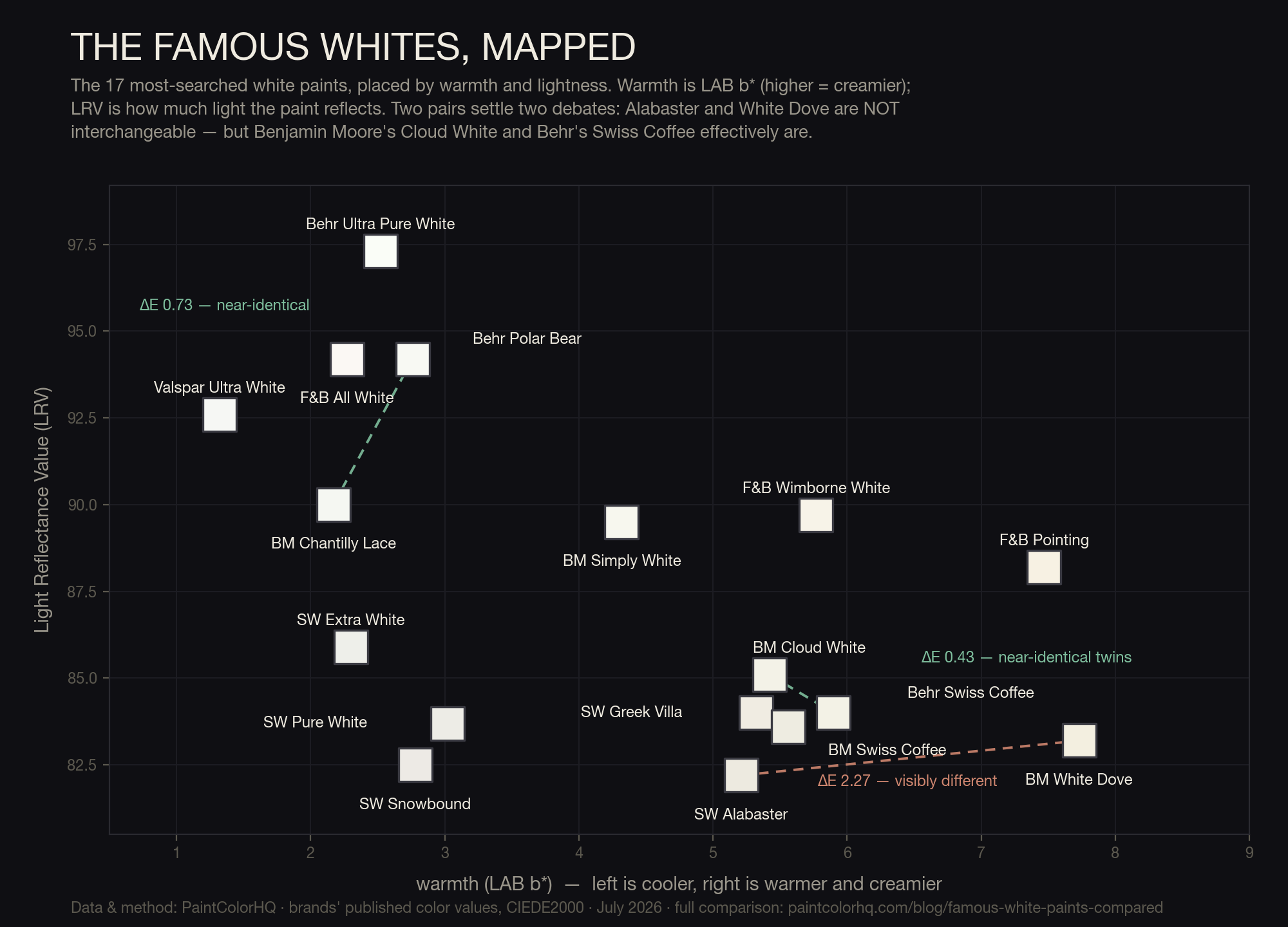
The most-asked white-paint question there is, and the data gives a clean answer: Alabaster (SW 7008) and White Dove (OC-17) measure Delta E 2.27 apart — a visible difference with the two side by side. White Dove is the warmest famous white on the market (LAB b* 7.7 to Alabaster's 5.2 — noticeably creamier) and slightly lighter (LRV 83.2 vs 82.2). They play the same role — a soft, warm, forgiving white — but swapping one for the other mid-project is not a safe substitution. Pick by the light in your room: White Dove leans cream, Alabaster stays closer to neutral.
The Secret Twins
Meanwhile, pairs almost nobody compares turn out to be nearly the same color:
| Pair | Difference | What it means |
|---|---|---|
| BM Cloud White + Behr Swiss Coffee | ΔE 0.43 | Near-identical — a premium classic and a big-box staple, effectively one color |
| SW Alabaster + SW Greek Villa | ΔE 0.68 | Same brand, near-identical — if you are agonizing between these two, stop |
| BM Chantilly Lace + Behr Polar Bear | ΔE 0.73 | Near-identical crisp whites across a large price gap |
| SW Alabaster + BM Swiss Coffee | ΔE 0.83 | The cross-brand swap for Alabaster loyalists in a Benjamin Moore store |
| BM White Dove + F&B Pointing | ΔE 1.29 | Very similar — the two premium warm whites are chasing the same target |
Same Name, Different Color
Six of the thirteen brands we track sell a color named “Swiss Coffee” — and they are not the same paint. Benjamin Moore's Swiss Coffee (OC-45) and Behr's Swiss Coffee (12) differ by Delta E 1.39: close, but Behr's runs lighter. The name is a category, not a formula — the same trap as “Antique White,” which eight brands sell under that exact name. (More of these in our paint color statistics.)
The Whitest White You Can Buy
Every brand has a ceiling — the lightest white it sells — and the ceilings differ more than you would expect. Behr Ultra Pure White tops the market at LRV 97.3. Sherwin-Williams' brightest, High Reflective White, reaches 92.6. PPG's lightest white measures just 88.7 — nearly nine points below Behr's. And if what you want is white with no undertone at all, the truest whites we measured are Dunn-Edwards Lighthouse and Behr Smart White — both nearly chroma-free at LRV 90.
Which Brand's Whites Run Warmest
Averaging the warmth of every white each brand sells (4,268 colors at LRV 75+), a brand personality shows up. Sherwin-Williams' whites run the coolest of any brand (average b* 7.8) — despite Alabaster's warm reputation, the SW white wall leans crisp. Hirshfield's (11.8) and Vista Paint (11.4) run warmest, with Benjamin Moore mid-pack (9.8) — though BM sells the warmest famous white of all in White Dove. Practical version: if you keep landing on whites that feel too cold, shop the warm half of the market; if your whites keep going cream on you, Sherwin-Williams and Valspar's cooler ranges are where to look.
How to Use This
Treat the map above as a shortlist tool: pick the warmth-and-lightness neighborhood your room needs, take the two or three names that live there, and compare them side by side. Then order physical samples of the finalists and look at them on your wall morning and evening — whites shift with window direction and bulb temperature more than any other color family. Our guide to paint undertones covers how to read what a white is doing in your light.
Methodology
Color differences are CIEDE2000 (Delta E 2000) computed from each brand's published color values; warmth is LAB b*; the whites universe is every color at LRV 75 or above across the 13 brands we track (4,268 colors) as of July 2026. Method details are on our methodology page; the cross-brand duplication analysis this builds on is in our study of duplicated paint colors. Published values describe the color target, not the liquid paint — sheen, texture, and pigment recipe still differ between brands, so confirm finalists with physical samples. If you cite this comparison, please link to this page.