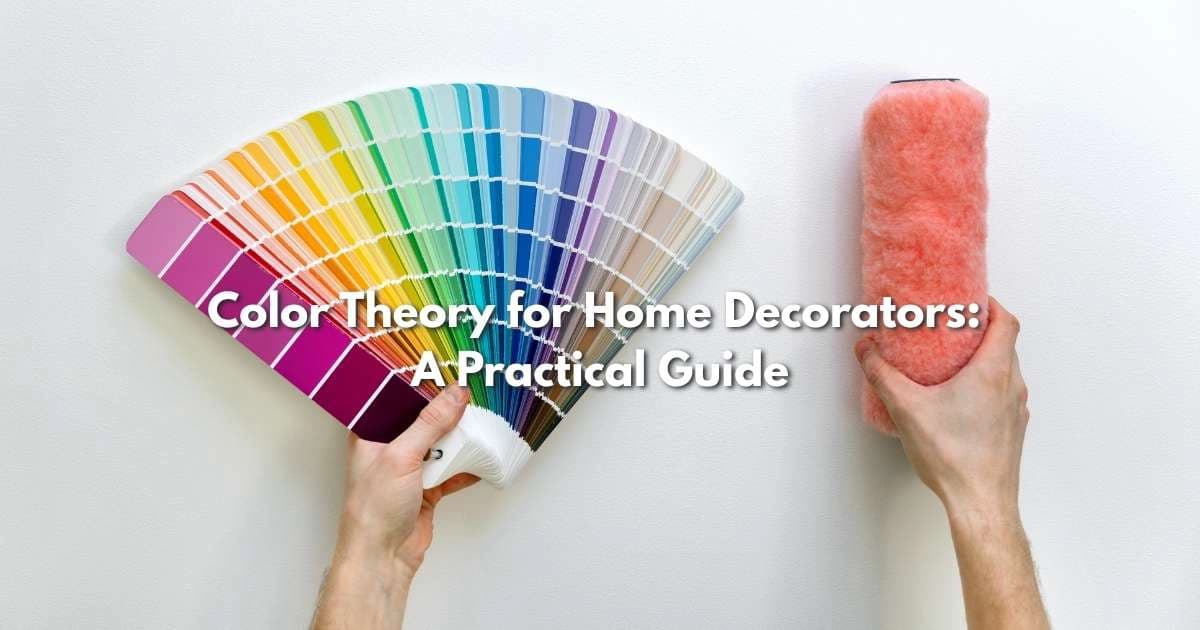
Color Theory for Home Decorators: A Practical Guide
Explore colors in this guide
Open a color for its details and cross-brand alternatives. Read on for the context behind each choice.
Most paint mistakes come from ignoring a small number of principles that designers use on every project: color temperature, color relationships, and proportion. This guide translates those principles into concrete decisions you can make at the paint store — no art background needed.
The Color Wheel (Simplified)
The color wheel arranges colors by their relationship: primary colors (red, blue, yellow) combine to make secondary colors (orange, green, purple). That's it — that's the foundation. What matters for decorating is the relationships between colors on the wheel.
Complementary Colors: Bold Contrast
Colors directly opposite each other on the wheel are complementary: blue and orange, red and green, yellow and purple. Used together, they create vibrant, energetic contrast. In home decor, this works best when one color dominates and the other accents.
Example: Naval(Sherwin-Williams) (blue) walls with Wholesome(Sherwin-Williams) (orange-brown) leather furniture and throw pillows. The contrast is dynamic without being chaotic. Every color page on Paint Color HQ shows you complementary paint matches automatically.
Analogous Colors: Easy Harmony
Colors adjacent on the wheel are analogous: blue, blue-green, and green. Because they share pigments, they read as naturally related even when placed in separate rooms. This is the structure behind most whole-home palettes that designers describe as “cohesive.”
Example: Saybrook Sage(Benjamin Moore) (soft green, LRV 46.4) in the living room, Quiet Moments(Benjamin Moore) (blue-green, LRV 61.6) in a bathroom, Silver Mist(Benjamin Moore) (cool blue, LRV 63.9) in a bedroom. Similar LRV levels and adjacent hues keep the transitions smooth. Browse all Benjamin Moore colors or see the green and blue families.
The 60-30-10 Rule
This is the single most useful decorating formula: 60% of the room should be one dominant color (usually walls), 30% should be a secondary color (furniture, rugs), and 10% should be an accent (throw pillows, art, accessories).
The dominant color sets the mood, the secondary color adds depth, and the accent provides interest. Use our palette generator to build a 3-color scheme based on any starting color.
Warm vs Cool: The Temperature Rule
Colors are divided into warm (red, orange, yellow) and cool (blue, green, purple). The single most important design principle: connected spaces should share the same temperature. A warm living room flowing into a cool kitchen feels disjointed. A warm living room flowing into a warm kitchen feels intentional.
Closed rooms (powder rooms, bedrooms, home offices) can break this rule freely. For the full explanation, read our warm vs cool guide.
Saturation and Value: The Sophistication Factor
Saturation is how vivid a color is. Value is how light or dark it is (measured as LRV in paint). The principle that separates most amateur paint choices from professional ones: reduce saturation, not hue. Bright, fully saturated colors feel jarring on full walls. The muted, grayed version of the same hue reads as sophisticated because it has depth without demanding attention.
A true cobalt blue (#0047AB) at full saturation on a living room wall is overwhelming. Quiet Moments(Benjamin Moore) (LRV 61.6) carries the same blue-green hue at a fraction of the saturation. It reads as refined, not juvenile. When a color feels wrong, the problem is usually too much saturation, not the wrong hue — go more muted before switching colors entirely.
Putting It Together
Step 1: Identify your fixed elements (flooring, countertops, large furniture) and note whether they're warm or cool.
Step 2: Choose a wall color in the same temperature family, at a low saturation. Use our color search and filter by undertone.
Step 3: Apply 60-30-10. Wall color is your 60%. Pick a secondary and accent using analogous or complementary relationships.
Step 4: Sample before committing. Our room visualizer gives a digital preview; physical samples give you the final answer.